Showing posts with label Tricks. Show all posts

Number Series Shortcuts and Mind Tricks

 Important Points to Remember:


i). If numbers are in ascending order in the number series.
Numbers may be added or multiplied by certain numbers from the first number.
     SET – I:
Step 1: Check whether it is ascending, descending, or mixed order.
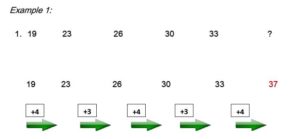
Step 2: It is  in ascending order. So add or multiply by certain numbers from the first number.
Step 3 : The difference between first number and second, and the difference between second and third and so on., are in increasing order of +4 and +3
Step 4: Hence the answer for the above series is 37.
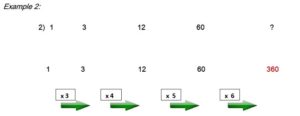
Step 1: Check whether it is ascending, descending, or mixed order.
Step 2: It is in ascending order. So add or multiply by certain numbers from the first number.
Step 3: By adding the first number and second, and second and third and so on., it is not in the sequence of increasing order. Try multiplication
Step 4: Take 1 and 3, let’s start multiplying 1*3=3, by seeing this we get to know, by multiplying 3*4 it gives 12, and 12*5=60.
Step 4: Hence the answer for the above series is 360.


ii). If numbers are in descending order in the number series,
Numbers may be subtracted or divided by certain numbers from the first number.
SET – II :
Step 1: Find whether the given number is in descending order.
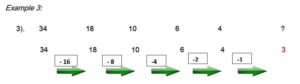
Step 2: It is in descending order. So subtract or divide by certain numbers from the first number.
Step 3: The difference between the first number and second, and the difference between second and third and so on, are in order of -16,-8,-4,-2
Step 4: Hence the answer for the above series is 3.
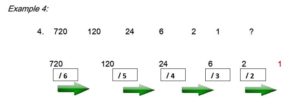
Step 1: Check whether it is ascending, descending, or mixed order.
Step 2: It is in descending order. So subtract or divide by certain numbers from the first number.
Step 3: By dividing the first number by 6 it gives 120.
Divide 120/ 5 =24, 24/4=6, 6/3=2, 2/2=1 .It is in decreasing order.
Step 4: Hence the answer for the above series is 1.
iii). If numbers are in mixing order (increasing and decreasing) in the number series.
Numbers may be in addition, subtraction, multiplication, and division in alternate numbers.
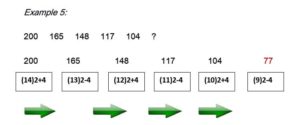
Step 1: Check whether it is ascending, descending, or mixed order.
Step 2: It is in mixing order. So it may be in addition, subtraction, division and multiplication, squares and cubes.
Step 3: In the above series, it is mixing of the square, addition, and subtraction.
(14)2= 196+4= 200
(13)2=169. By adding 4 it gives 173. Try subtraction.
169-4=165
Here we found it is in order of squaring a number, adding by 4, and subtracting by 4.
Step 4: Hence the answer for the above series is 77.
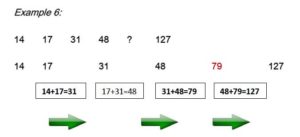
Step 1: Check whether it is ascending, descending, or mixed order.
Step 2: It is in ascending order. So add or multiply by certain numbers from the first number.
Step 3: In the above series, let’s add the first number with 3 i.e.,14+3= 17
But with the second number, we can’t able to add +3 and so on.
Let’s try adding the first number and second number i.e. 14+17=31
Second and third, i.e. 17+31 =48 and so on
This series is in the form of miscellaneous
Step 4: Hence the answer for the above series is 79


Aptitude Shortcuts and Tricks for Allegation & Mixture Problems

 Aptitude Shortcuts and Tricks for Allegation & Mixture Problems:

Dear Readers, Aptitude Shortcut methods and tricks for the problems related to Allegation & Mixture were given below. Candidates who are preparing for upcoming exams can use this.

Allegation & Mixture

Type-1: If a mixture contains two liquids in the ratio a:b and if x liter of b is added to the mixture, then the ratio of two liquids becomes a:c, then the quantity of liquid in the mixture is given by
[ax/(c-b)] and that of liquid b is given by [bx/(c-b)].
Example: A mixture contains milk and water in ratio 4:3. If 5 litres of water is added to the mixture. The ratio becomes 4:5. The quantity of milk [(4×5)/(5-3)]= 20/2= 10 litre.


Type-2:A container initially contains x unit of liquid and a unit of liquid is taken out and it is filled with a unit of water repeatedly up to n times, then the final quantity of the original liquid in the container is given as
Example: A container has 60 litres of milk, from this container, 4 litres of milk is taken out and replaced with water. If this process is repeated 3 times, then the quality of milk in the container is left.


Type-3:A Container has milk and water in the ratio a:b, a second container has milk and water in the ratio c:d. If both the mixture is emptied into a third container, then the ratio of milk to water in the third container is given by
Example: 3 Container has milk and water in the ratio 2:1, 3:1, 3:2 respectively and all three containers are emptied into a bigger container, the ratio of milk to water in a bigger container.

Aptitude Tips and Tricks on Percentage

 PERCENTAGE

What is Percentage: A fraction with its denominator as ‘100’ is called a percentage. Percentage means per hundred. So it is a fraction of the form 6/100, 37/100, 151/100, and these fractions can be expressed as 6%, 37%, and 151% respectively. By a certain percent, we mean that many hundredths. 

Thus x percent means x hundredths, written as x%.  

To express x% as a fraction:We have, x% = x/100.  

Thus, 20% =20/100 =1/5; 48% =48/100 =12/25, etc.  

To express a/b as a percent:We have, a/b = ((a/b)*100)% 

Thus, ¼ =[(1/4)*100] = 25%; 0.6 =6/10 =3/5 =[(3/5)*100]% =60% 

Why Percentage: Percentage is a concept evolved so that there can be a uniform platform for comparison of various things. (Since each value is taken to a common platform of 100) 

Example: To compare three different students depending on the marks they scored we cannot directly compare their marks until we know the maximum marks for which they took the test. But by calculating percentages they can directly be compared with one another. 

Important Points to Remember: 

a)If the price of a commodity increase by R%, then the reduction in consumption so as not to increase  the expenditure is  

[R / (100+R))*100] % 

b)If the price of the commodity decreases by R%, then the increase in consumption so as to decrease the  expenditure is  

[(R / (100-R)*100] % 

c)If A is R% more than B, then B is less than A by  

[(R/(100+R))*100]% 

  1. d) If A is R% less than B, then B is more than A by  

[(R/(100-R))*100]% 

Results on Population: Let the population of the town be P now and suppose it increases at the rate of  R% per annum, then:  

  1. Population after n years = P [1+(R/100)]n
  2. Population n years ago = P / [1+(R/100)]n

Results on Depreciation: Let the present value of a machine be P. Suppose it depreciates at the rate of R%  per annum. Then,

  1. Value of the machine after n years = P [1-(R/100)]n
  2. Value of the machine n years ago = P / [1-(R/100)]n

10 Important Short Tricks of Profit And Loss Problems

 Basic Concept of Profit and Loss Problems:

  • Cost Price (CP) –> Price at which an article is Purchase
  • Marked Price (MP) –> Price written on the article/MRP
  • Selling Price (SP) –> Price at which an article is sold
  • Profit –> SP> CP                Profit = SP – CP
  • Loss –> CP> SP                 Loss = CP – SP
  • Profit% or Gain % –> Profit /CP ×100% = SP – CP / CP ×100%
  • Loss% –> Loss/CP ×100% = CP – SP / CP×100%

Useful Shortcuts and Tricks for Simple Interest & Compound Interest


Useful Shortcuts and Tricks for Simple Interest & Compound Interest

Simple Interest:

Formula:

1) SI = P x R x T/100 

2) Principal = Simple Interest ×100/ R × T
3) Rate of Interest = Simple Interest ×100 / P × T
4) Time = Simple Interest ×100 / P × R

5) If the rate of Simple interest differs from year to year, then

Simple Interest = Principal × (R1+R2+ R3…..)/100


The four variables in the above formula are: 
SI=Simple Interest P=Principal Amount (This the amount invested)T=Number of yearsR=Rate of interest (per year) in percentage
1). A sum of money is divided into n parts in such a way that the interest on the first part at r1% for t1 years, on the second part at r2% for t2 years, on the third part at r3% for t3years, and so on, are equal. Then the ratio in which the sum is divided in n part is:
1/r1×t1: 1/r2 ×t2: 1/r3×t3
Example:
A sum of Rs 7700 is lent out in two parts in such a way that the interest on one part at 20% for 5 yr is equal to that on another part at 9% for 6 yr. Find the two sums.
Solution:
Here, R1 = 20% R2 = 9%

T1 = 5 yr T2 = 6 yr

By using formula, ratio of two sums  = 1/100 : 1/54 = 27 : 50

Therefore, first part = [27/(27+50)]*7700 = Rs 2700

Second part = [50/(27+50)]*7700 = Rs 5000
 
2). Amount = Principal + S.I = p + [(p x r x t)/100]

Five Most Important Shortcuts for Time Speed Distance


Five Most Important Shortcuts for Time Speed Distance

Formula:


  • Distance = Speed × Time
  • Time = Distance/Speed
  • Speed = Distance / Time
  • Convert Km/h to M/s =Km/h * 5/18 = m/s or m/sec *18/5 = km/h
  • Calculate Average Speed = 2xy/x+y
  • Two person may walk in same direction or in opposite direction.